

Did you know that the most dangerous real estate in your entire facility is the 6-inch gap between your dock and the trailer?
How you bridge it dictates:
- Your SAFETY
- Your SPEED
- Your BOTTOM LINE
Moving freight from a facility to a trailer shouldn’t be a bottleneck or a safety hazard. Whether you are operating from a dedicated loading dock or a flat paved lot, having the exact right equipment—Yard Ramps, Dock Boards, or Dock Plates—is the difference between a smooth transition and a catastrophic dropped load.
Why the Right Bridging Equipment is Non-Negotiable:
- Eliminate Bottlenecks (Yard Ramps): No dock? No problem. Heavy-duty yard ramps instantly turn any paved surface into an active loading dock, allowing you to scale operations and load/unload trailers anywhere, anytime.
- Heavy-Duty Safety (Dock Boards): When forklifts are crossing the gap, you need serious structural integrity. Steel dock boards with curbs prevent forklifts from driving off the edge and absorb the extreme weight of motorized equipment.
- Manual Agility (Dock Plates): For hand trucks and pallet jacks, lightweight aluminum dock plates provide a fast, ergonomic bridge. Using the right lightweight tool for manual jobs speeds up loading while saving your workers’ backs.
- Preventing “The Drop”: Using the wrong equipment—like a dock plate for a forklift—is a massive liability. Proper bridging equipment prevents jarring bumps that damage forklift tires, spill expensive product, and cause severe worker injuries.
Bottom Line: Speed means nothing if the transition isn’t safe. Investing in the proper boards, plates, and ramps doesn’t just bridge a physical gap – it bridges the gap between downtime and profitability.
SPRING SPECIAL OFFER: Receive 10% off all yard ramps, dock plates, and dock boards: BRIDGEGAP10
Contact us today by completing this form or call 800-794-5438.
CHOOSING YOUR BRIDGE: The Fast Guide to Matching Your Loading Equipment to Your Operational Reality
YARD RAMP:
- Your operations start on PAVED GROUND (no dock)
- You are loading into a standard semi-trailer
DOCK BOARD or DOCK PLATE:
- If your operations start on a CONCRETE LOADING DOCK
- You are loading into a standard semi-trailer
Plates vs. Boards vs. Ramps
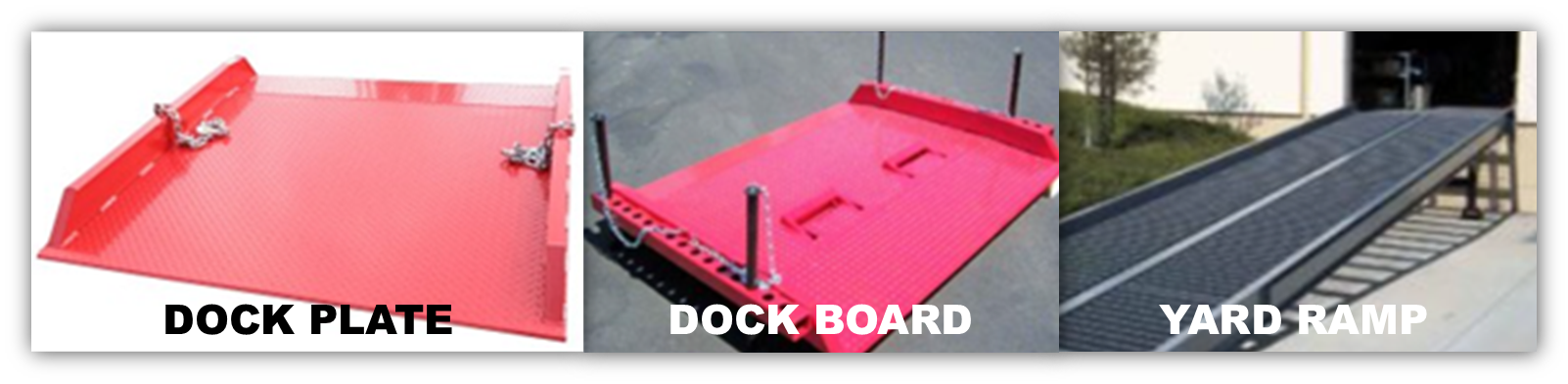
DOCK PLATE:
- Primary traffic: Manual
- Equipment type: Hand trucks, pallet jacks, foot traffic
- Key safety type: Smooth surface for small wheels; locking legs
- Material: Usually high-strength aluminum
- Load capacity: Light to medium
- Best used for: Box trucks, last-mile delivery, light pallet moves
DOCK BOARD:
- Primary traffic: Motorized
- Equipment type: Forklifts, stand-up riders, high-capacity movers
- Key safety type: Safety Curbs to prevent forklift runoff; locking legs
- Material: Heavy-duty steel (or reinforced aluminum)
- Load capacity: Heavy to extreme
- Best used for: High-volume docks constantly moving heavy freight with forklifts
YARD RAMP:
- Primary traffic: Motorized
- Equipment type: Forklifts (driving from ground to trailer)
- Key safety type: Traction grating; integrated side curbs; hydraulic/mechanical lift
- Material: Steel (frame and grating)
- Load capacity: Extreme (heavy-duty)
- Best used for: Facilities with no dock, satellite operations, and scaling dock capacity instantly